
On December 4th of 2009, Adidas presented the official World Cup ball of 2010: the Jabulani. The word Jabulani means celebration or party in the Zulu dialect.
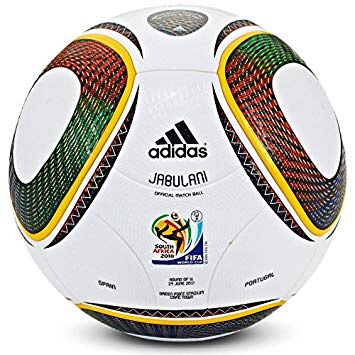
This ball was presented as a technological jewel, created by the AIT (Adidas Innovative Team). It consisted of 8 welded panels, 4 minor triangles and 4 bigger ones, which gave the ball a smooth and perfect sphere shape that has never been done before. The panel surface is a 3D non slip compound called Grip and Groove, commonly known as a goose skin. It had been tested before in the 2008 European Championship. This type of surface allowed a grip on all types of conditions. These panels were crossed by particular channels, which ensured the designers as an improvement in aerodynamics of the ball.
Eleven different colors were assigned to this ball to show the decorations on the Jabulani. This certain design indicates that this was the eleventh Adidas World Cup ball, but also 11 is the number of players on a team and 11 is the official languages of South Africa. The 4 smaller triangles on the ball recall the external facade of the Soccer City Stadium in Johannesburg. This was the place where the World Cup was held in South Africa. Adidas put one of the match balls on eBay for auction and it was sold for 73,769 dollars, the money was provided for charity (Nelson Mandela Fund). There were only 15 match balls provided and imprinted for each match. If the ball was actually used in the game, they put a unique stamp on the ball indicating that it was actually used during the game.
I found my information at https://www.popularmechanics.co.za/tech/the-science-behind-jabulani-the-2010-official-match-ball-including-video/, so I would like to credit them for my work.

 TKZ Lifestyle